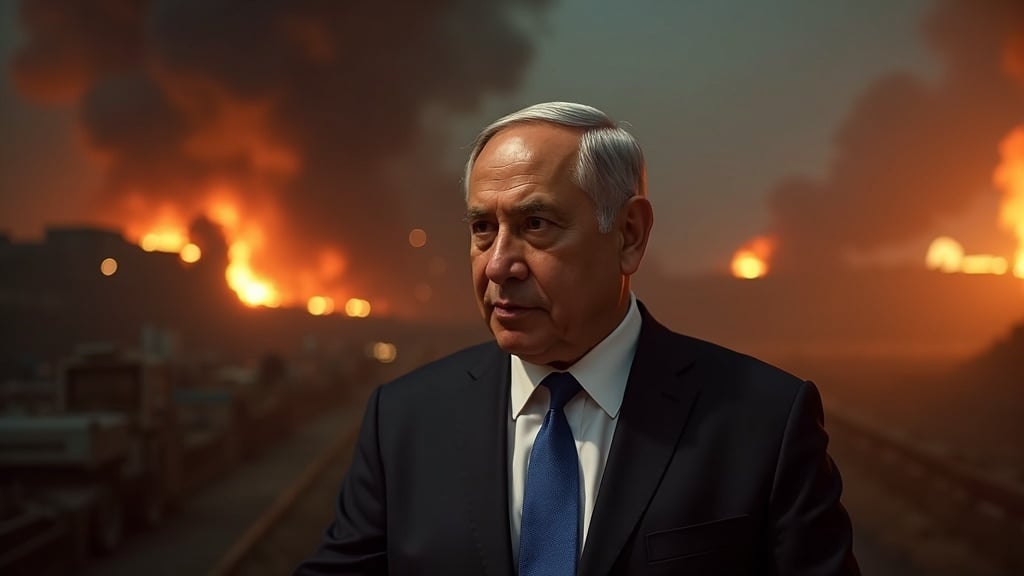
srael has signalled its intent to escalate military strikes against Hezbollah, following a series of retaliatory attacks on targets in eastern Lebanon. Prime Minister Benjamin Netanyahu's announcement comes amid rising regional tensions, with implications for the broader Middle East.
The decision to intensify strikes follows a pattern of cross-border hostilities that have persisted for years. Hezbollah, a Shia Islamist political and military organisation based in Lebanon, has long been a thorn in Israel's side. Its alliance with Iran and involvement in the Syrian civil war have further complicated the security landscape.
Hezbollah emerged in the 1980s during Lebanon's civil war, gaining strength with support from Iran. It has since evolved into a formidable military force, with a significant political presence in Lebanon. The group's arsenal includes an extensive rocket and missile capability, posing a direct threat to Israel.
The recent Israeli strikes targeted Hezbollah positions and infrastructure in eastern Lebanon, areas that Israel claims are used to launch attacks and store weapons. The Israeli military employed air strikes and artillery fire, aiming to degrade Hezbollah's operational capabilities. These actions follow a series of rocket attacks from Lebanon into Israeli territory, which Israel attributes to Hezbollah.
The mechanism of these strikes involves precise intelligence gathering and rapid response. Israel's military, known for its technological edge, utilises drones, satellites, and ground sensors to monitor Hezbollah's movements. Once targets are identified, fighter jets and attack helicopters are deployed to carry out the strikes. The sequence typically involves initial reconnaissance, followed by a swift and coordinated attack to maximise impact and minimise casualties.
This escalation raises the spectre of a wider conflict. Hezbollah has vowed to respond to Israeli aggression, potentially drawing in other regional players. Iran, Hezbollah's key backer, could be compelled to increase its support, further inflaming the situation. The involvement of proxy forces and the risk of miscalculation cannot be discounted.
At stake is the fragile stability of the Middle East. A full-scale war between Israel and Hezbollah would have devastating consequences for Lebanon, already reeling from economic crisis and political instability. It could also spill over into Syria, where various factions are entrenched, and impact the broader Iranian-Israeli rivalry.
The international community watches with bated breath. The United States, a key ally of Israel, has called for restraint, while European nations urge dialogue to de-escalate tensions. The United Nations has highlighted the need to respect Lebanon's sovereignty and avoid further destabilisation.
What to watch in the coming days is Hezbollah's response. Any significant retaliation could trigger a rapid escalation. The international community's ability to mediate and prevent a broader conflict will be crucial. The role of Iran and its willingness to support Hezbollah will also be a key factor in determining the trajectory of this conflict.
The coming days will be critical in determining whether this escalation leads to a broader conflict or if diplomatic efforts can reign in the hostilities. The world watches as the Middle East teeters on the edge of yet another volatile chapter.