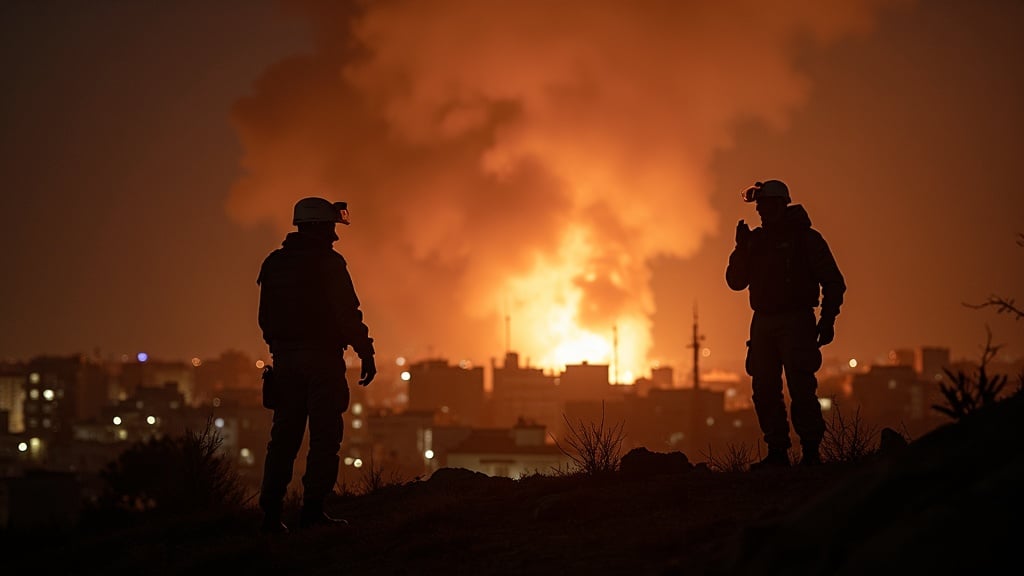
series of Israeli strikes in southern Lebanon has resulted in the deaths of 11 people, predominantly civilians, according to local reports. The attacks come as Israel intensifies its military operations against Hezbollah, following Prime Minister Benjamin Netanyahu's vow to 'crush' the militant group.
The strikes underscore the escalating tensions between Israel and Hezbollah, a Shiite militant organisation backed by Iran. This conflict has the potential to destabilise the already volatile region, drawing in other players and leading to a wider conflagration.
To understand the current crisis, one must look back to the long history of conflict between Israel and Hezbollah. The two sides have clashed numerous times since Hezbollah's formation in 1985, most notably in the 2006 Lebanon War. That conflict ended in a stalemate, but the animosity between the parties has persisted.
Hezbollah, which operates as both a political party and a paramilitary group, holds significant sway in Lebanon. It is part of the governing coalition and maintains a formidable arsenal, much of it supplied by Iran. Israel views Hezbollah as a direct threat, given the group's rocket capabilities and its stated aim of destroying the Jewish state.
The recent Israeli strikes targeted what the Israeli Defence Forces described as 'Hezbollah infrastructure sites and fighters' across Lebanon. The operation, which Israel says hit over 100 sites, follows a pattern of tit-for-tat violence that has characterised the Israel-Hezbollah relationship for decades.
Hezbollah has retaliated with rocket attacks into northern Israel, though these have largely been intercepted by Israel's Iron Dome defence system. The group has vowed further revenge, setting the stage for a potential escalation.
The strikes have caused alarm among Lebanon's civilian population, particularly in the south, a Hezbollah stronghold. The 11 reported deaths include women and children, raising concerns about the humanitarian impact of the conflict.
The current escalation is particularly concerning given the fragile state of Lebanese politics. The country is grappling with an economic crisis, political instability, and the aftermath of the 2020 Beirut port explosion. The last thing Lebanon needs is a full-scale war on its southern border.
The international community is watching closely. The United States, a key ally of Israel, has called for restraint, as has the United Nations. However, the deep-seated animosities and the regional power dynamics at play make de-escalation far from certain.
What is at stake here is not just the immediate loss of life and infrastructure, but the potential for a wider regional conflict. Iran, Hezbollah's main backer, has warned Israel against further aggression, hinting at possible repercussions.
For Israel, the goal is to weaken Hezbollah and deter future attacks. For Hezbollah, the strikes are seen as an affront that demands a response. The civilian casualties only serve to harden positions on both sides.
The coming days will be crucial. If Hezbollah opts for a measured response, the conflict could remain contained. However, if it chooses to escalate, we could see a return to the devastating levels of violence witnessed in 2006.
The international community must engage all parties to prevent further bloodshed. The stakes are high, not just for the people of Lebanon and Israel, but for the stability of the entire Middle East.