Three in four staff are abused
A new report from the Royal College of Emergency Medicine has laid bare the abuse faced by hospital workers. The findings are stark. Nearly three quarters of accident and emergency staff in the United Kingdom now experience violence or aggression from the public on a daily or a weekly basis. This is not an isolated problem. It is a national crisis. The survey data shows that for almost 75 per cent of frontline medics, this type of confrontation is no longer a rare or shocking event but a persistent and predictable feature of their working lives. The abuse happens every day. It happens every week. The professional body for emergency doctors has quantified what its members have known for years.
What was once unimaginable is now routine. The survey highlights how abuse has become a normalised part of the job. Staff expect it. This acceptance of hostility as a standard condition of employment is one of the report’s most significant findings, painting a picture of a profession under siege. Emergency workers who are trained to save lives and provide care are instead spending their shifts managing aggression and deescalating threats to their own safety. Reporting on the survey noted the situation was described as 'appalling'. It is a profound shift. The very nature of the role has changed.
The aggression takes many forms. The Royal College of Emergency Medicine’s survey uses the broad terms of violence and aggression, which can encompass a range of hostile behaviours directed at staff. This can mean verbal abuse. It can mean being shouted at or threatened by frustrated patients or their relatives. It can also mean physical violence. The data does not separate the two, treating them as part of the same phenomenon of escalating conflict within hospital waiting rooms and treatment bays. For the staff on the receiving end, the distinction is often academic. The threat is constant.
The wait is the trigger
The report connects the abuse directly to the hospital environment. It is not spontaneous malice. It is a reaction. The primary causes are long waiting times and severe overcrowding in understaffed departments. This is the trigger. The Royal College of Emergency Medicine argues that these systemic failings are creating the conditions for conflict, turning waiting rooms into highly volatile spaces. Patients are left for hours. They are often in pain. Staff become the focus of a frustration that is aimed at the entire system.
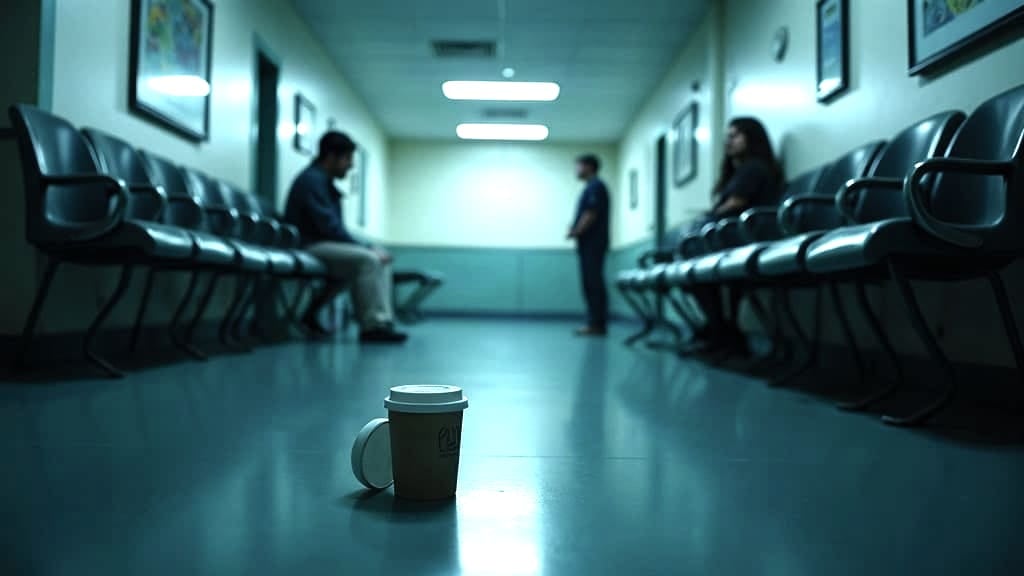
The scale of this waiting is captured in official data. These figures are stark. NHS Digital data for July 2026 shows that the four hour target, a national standard dictating that 95 per cent of patients should be seen and then discharged, admitted or transferred in that time, was met for only 65 per cent of attendances across England, the worst figure on record. This single statistic represents millions of individual delays and prolonged stays in uncomfortable plastic chairs under the flat glare of fluorescent lights. The target has not been met nationally since 2015. The recent collapse in performance, however, has created a new, more confrontational atmosphere.
The most extreme waits show the system at its most broken. A different metric reveals the sharpest end of the crisis. These are the trolley waits. People wait on trolleys. They wait in corridors. In the most recent month with complete data, August 2026, more than 42,000 patients in England waited more than twelve hours for a hospital bed after a doctor had already decided they needed to be admitted. This is not a wait for treatment. It is a wait for a ward. The number represents a near complete breakdown in the flow of patients from the front door of the hospital to a bed. A wait of half a day in a busy corridor is now common.
The aggression is a direct response to this environment. The Royal College of Emergency Medicine is clear on this point. Patients and their relatives are being placed in an impossible situation by a healthcare service that cannot meet their needs in a timely way. The long waits are made worse by a lack of space and a lack of privacy. They are compounded by a lack of information from a workforce stretched too thin to communicate effectively with every waiting family. It is predictable. A person in pain, or a person watching a loved one suffer for hours without a clear plan, becomes frustrated. That frustration can turn to anger. The anger is then directed at the nearest available person. That person is usually a nurse or a doctor.
Medics are voting with their feet
This abuse has consequences. Medics are leaving the profession. They are voting with their feet. The Royal College of Emergency Medicine has described a workforce ground down by the daily reality of the job, a reality which now includes being shouted at, threatened, or physically assaulted. A career in emergency medicine is being rendered untenable for a growing number of doctors and nurses who entered the field to care for people, not to manage public disorder. This is not a sustainable situation. For many, the calculation is simple. The personal cost of working on the NHS frontline, of absorbing the anger generated by a failing system, has become too high. The salary no longer compensates for the psychological damage. So they resign.
The specialty was already fragile. It has long struggled with recruitment and retention. NHS workforce statistics have for years shown that emergency medicine has one of the highest turnover rates in the health service, a constant churn of staff that makes building stable, experienced teams difficult. Burnout is a recognised problem. The British Medical Association, a union representing doctors, has published extensive research on the condition, showing how sustained stress leads to emotional exhaustion and a detached, cynical outlook. The addition of routine violence and aggression from the public acts as an accelerant on this pre-existing fire, turning a chronic problem of staff attrition into an acute crisis. People who might have coped with the clinical strain cannot also cope with being a target.
Losing these staff members creates a vacuum. It is a loss of expertise. A consultant who leaves after fifteen years in the emergency department takes with them an irreplaceable body of knowledge built from treating thousands of patients. They take the ability to make rapid, life or death decisions under immense pressure. They also take their role as a teacher and supervisor for the next generation of doctors who are rotating through the department as part of their training. When these senior figures depart, the burden of responsibility shifts downwards onto more junior colleagues. They are left with less support. They are more likely to make mistakes. They are also more likely to burn out themselves and leave. It is a vicious cycle.
This exodus directly impacts patient care. Fewer staff means the remaining teams are stretched even thinner across the same number of patients arriving at the hospital's front door. This makes it impossible to reduce the waiting times which are the primary source of the public's anger. The Royal College of Emergency Medicine is clear. The understaffing identified in its survey is not just a background condition, it is actively being worsened by the very abuse it helps to create. The system is consuming itself. Each nurse who resigns because of a threat, and each doctor who takes early retirement after being assaulted, makes the department less safe for the next patient. They also make it less safe for the next member of staff.
Body cameras are not a cure
Officials have tried to act. The problem is not new. Parliament passed the Assaults on Emergency Workers Act in 2018, a law specifically designed to protect frontline staff by increasing the penalties for anyone convicted of attacking them. It doubled the maximum sentence for common assault. From six months to twelve. The legislation was intended as a deterrent. Yet the Royal College of Emergency Medicine survey shows that abuse is now routine, suggesting that the threat of a longer prison sentence has little effect on a person in distress after waiting ten hours for treatment. The law punishes an outcome. It does not prevent it.
Hospitals have also invested in physical security. Many A&E departments now have guards on site around the clock, a presence intended to offer reassurance to staff and act as a visible warning to potentially aggressive patients and their relatives. They are a last resort. They are there to de-escalate situations or, if necessary, restrain people. Their presence confirms the department is a dangerous place to work. It is an admission of failure. It shows the environment is no longer considered fundamentally safe. The guards are treating a symptom. They cannot address the cause of that symptom which is the long, frustrating, and often painful wait for care. They are a sticking plaster on a structural wound.
More recently, individual hospital trusts have begun trialling body worn cameras for staff. This is the same technology used by police forces across the country. The logic is that a camera creates an objective record of any interaction. It gathers evidence for a potential prosecution. It might modify the behaviour of someone who knows they are being filmed. But this is another reactive measure. It does nothing for the patient with a suspected fracture who has been sitting on a plastic chair since lunchtime. It does not magic a free cubicle out of thin air for the nurses trying to manage their care. These security interventions treat the consequence of systemic failure, not the failure itself. They are an admission that the state can no longer guarantee a safe workplace for its own medical staff simply by providing timely medical attention. A camera cannot shorten a twelve hour wait.
The system is feeding on itself
The system is feeding on itself. The logic is brutal. Long waits fuel patient aggression. That aggression drives medical staff away from the profession, or into other, safer parts of the hospital. Fewer staff remain to treat the same number of patients. This inevitably leads to even longer waits for everyone. The waits get worse. The aggression increases. This is the feedback loop now operating inside NHS emergency departments. It is a self perpetuating mechanism of decay.
This departure of staff is not a single event. It is a constant, attritional loss. It is the experienced registrar who moves to a general practice in a quiet suburb after being threatened for the third time in a month. It is the nurse who takes long term sick leave for stress, leaving their shift permanently one person short. It is the newly qualified doctor who chooses to emigrate to Australia rather than face a career defined by abuse and impossible pressure. Each departure removes not just a body, but years of accumulated skill and expertise from the front line. The remaining team becomes less experienced, more stretched, and increasingly demoralised. Their ability to process patients efficiently is compromised. It slows everything down.
The consequences for patients are direct and measurable. A department weakened by staff burnout cannot meet its targets. It cannot provide timely care. The patient with a suspected heart attack waits longer for an ECG. The child with a high fever sits for hours in a crowded, noisy room full of distressed adults. Their frustration is not abstract. It is born of pain, anxiety, and the feeling of being abandoned within a system that is supposed to help them. This environment, a direct result of the staffing crisis, creates the exact conditions for the confrontations that the Royal College of Emergency Medicine's report describes. The system itself is generating the abuse. It is provoking the attacks.
This is not a sequence of isolated problems. It is a single, integrated collapse. Each element of the crisis amplifies the others in a closed circuit. Violence causes staff shortages. Staff shortages cause longer waits. Longer waits cause more violence. The interventions currently in place, such as body cameras or on site security, do not and cannot interrupt this process because they operate outside the loop itself. They are tools for managing the symptoms of the breakdown, not for fixing the faulty machine that produces them. The structure is failing. It is consuming the very people it needs to function. The result is an emergency service that is becoming progressively more dangerous for its staff and less effective for its patients, month by month.
Whitehall's plan meets reality
The government has a plan. It has numbers. The Department of Health and Social Care’s Urgent and Emergency Care Recovery Plan, published in January 2023, promised that 76 per cent of patients attending A&E would be seen within four hours by the spring of 2024. This was an interim step towards the official 95 per cent standard, a target that has not been met nationally since 2015. The prime minister, Rishi Sunak, also made cutting the overall NHS waiting list one of his five pledges to the public.
The frontline looks different. The Royal College of Emergency Medicine report describes a reality starkly at odds with these ambitions, one where staff experience routine violence directly caused by the very delays the policies are meant to fix. The system is not improving. It is getting worse.
Whitehall's other central policy document is the NHS Long Term Workforce Plan. Published in June 2023, it sets out a fifteen year vision to recruit and, crucially, to retain hundreds of thousands of doctors, nurses and other health professionals. Retention is key. The plan depends on it. But a climate of fear and abuse actively works against this, pushing experienced medics to leave the profession long before any new recruits can be trained to replace them.
A profound disconnect exists between the stated goals of national policy and the lived experience of staff working in emergency departments across the country. The government's strategy assumes a stable workforce on which to build for the future. The RCEM's findings suggest that foundation is actively eroding. The plans are for a system that works. The reports are from one that does not.
Sources. Guardian UK: Almost 75% of A&E staff in UK face violence or aggression daily or weekly. Independent UK: A&E staff face daily violence and abuse from patients, survey reveals.
Analysis. Drafted with AI assistance from the sources listed above and reviewed by an editor before publication. Jnews links to the organisations it writes about.